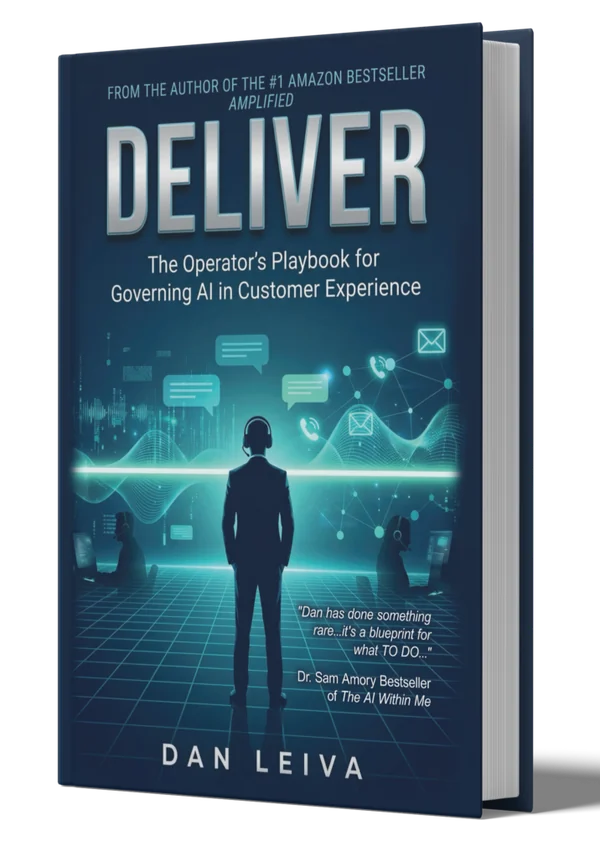
DELIVER
The Operator's Playbook for Governing AI in Customer Experience
AI now makes decisions your customers live with. DELIVER shows you how to put a named owner behind every one of them.
- Publishing November 10, 2026
- From the author of AMPLIFIED, a #1 Amazon bestseller
Find out what your AI's wrong decisions really cost.
Most AI business cases count the savings and leave out the decisions the AI gets wrong. Those costs land in other budgets: repeat contacts, recovery work, refunds, and customers who leave. This calculator puts them back on the same page, using the method from Chapter 9 of DELIVER.
Enter your numbers for one decision type. You get your cost per bad decision, your break-even error rate, and a one-page return you can hand to your CFO.
Get the Decision Boundary Self-Audit
Sort every AI decision in your operation in about 20 minutes. Join Dan's list for the audit and occasional notes on governing AI in customer experience. The calculator works without it.
The arithmetic from Chapter 9, on your numbers.
The results are estimates based on the numbers you enter. They are not financial advice. Treat them as estimated until a pilot or finance review proves them.
Every metric was green. The customer was still gone.
AI agents now answer customers, issue refunds, and make decisions that used to belong to people. Most companies can tell you how many contacts their AI handled. Few can tell you who owns the decision when it gets one wrong.
DELIVER is the operator's playbook for closing that gap. Dan Leiva draws on 25 years running customer operations at Apple, Intuit, eBay, and Travelers to lay out a seven-stage method for putting AI in front of customers with named owners, clear boundaries, and a gate that nothing passes without evidence.
Inside, you'll learn how to:
- Decide which decisions AI can make alone, which need a person, and which it should never touch
- Name an owner for every automated decision before it reaches a customer
- Measure the cost of a bad decision alongside the cost per resolution
- Protect the frontline people who handle what the AI can't
- Prove the financial return to a CFO who wasn't in the room
- DDiagnoseMap the decisions your AI makes and where they fail customers.
- EEngineerName the experience, draw the decision boundary, then design the screen.
- LLockThe gate. Nothing goes forward without a named owner.
- IIncubatePilot in real conditions, with kill criteria set in advance.
- VValidateProve the model holds at scale, across every system a decision touches.
- EEmbedKeep ownership working through drift, model updates, and turnover.
- RReturnProve value a CFO trusts without hollowing out the experience.
Dan Leiva
Dan Leiva has spent 25 years running customer operations and the technology behind them at Apple, Intuit, eBay, and Travelers. At eBay, his teams raised AI resolution from 67 percent to more than 91 percent while customer satisfaction more than doubled. He is the founder of CXAmplify, the author of AMPLIFIED, a #1 Amazon bestseller, and a United States Marine Corps veteran.
DELIVER publishes November 10, 2026.
AI doesn't remove the need for an owner. It removes the places an unowned decision can hide.