The New Book
Publishing November 10, 2026 From the author of AMPLIFIED, an Amazon #1 Bestseller

How do you know your AI is working for the customer before the customer tells you it isn't?

DELIVER is the operator's playbook for governing AI in customer experience. It gives leaders a seven-stage method for putting AI in front of customers without losing track of who owns each decision it makes.

Containment is up. Handle time is down. Cost per contact fell. And the customers most exposed to the agent are the ones leaving. DELIVER shows you why the dashboard missed it, and what to change.

"Dan has done something rare...it's a blueprint for what TO DO..."

Dr. Sam Amory, bestselling author of The AI Within Me
25+
Years Running CX Operations
7
Stages in the Method
59
Operator Tools
2006
First Bot in Front of Customers
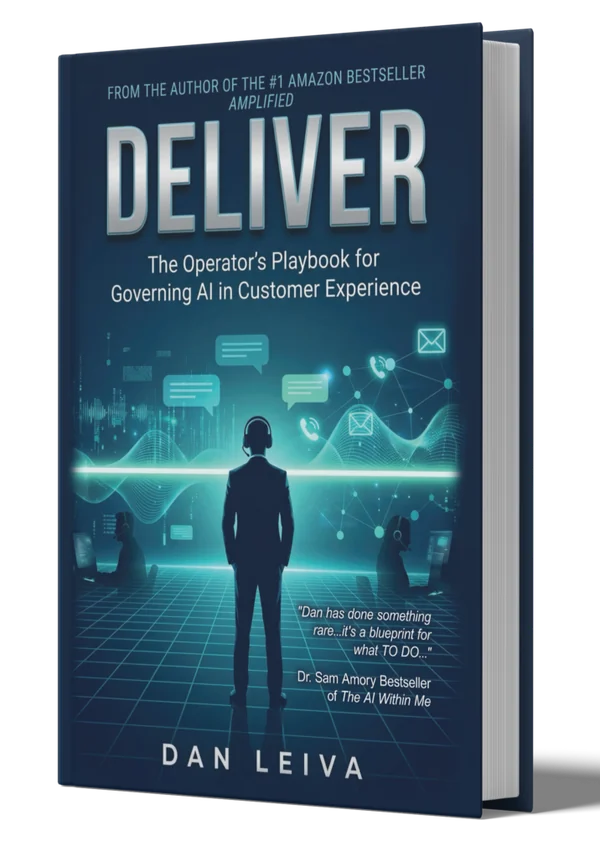
DELIVER: The Operator's Playbook for Governing AI in Customer Experience, by Dan Leiva
November 10, 2026 Beyond Publishing
APPLE · INTUIT · EBAY · TRAVELERS · AUTHOR OF AMPLIFIED AND DELIVER · FOUNDER OF CXAMPLIFY · USMC VETERAN · FIRST BOT IN FRONT OF CUSTOMERS IN 2006 · APPLE · INTUIT · EBAY · TRAVELERS · AUTHOR OF AMPLIFIED AND DELIVER · FOUNDER OF CXAMPLIFY · USMC VETERAN · FIRST BOT IN FRONT OF CUSTOMERS IN 2006 · APPLE · INTUIT · EBAY · TRAVELERS · AUTHOR OF AMPLIFIED AND DELIVER · FOUNDER OF CXAMPLIFY · USMC VETERAN · FIRST BOT IN FRONT OF CUSTOMERS IN 2006 · APPLE · INTUIT · EBAY · TRAVELERS · AUTHOR OF AMPLIFIED AND DELIVER · FOUNDER OF CXAMPLIFY · USMC VETERAN · FIRST BOT IN FRONT OF CUSTOMERS IN 2006 ·

Reading DELIVER? The Cost per Bad Decision Calculator from Chapter 9 is at cxamplify.com/deliver.

Open the calculator

A working method for the operators who live with what they deploy.

Every stage comes from 25 years of putting automation in front of customers, including the mistakes. After reading DELIVER, you will:

01

Find Intent Theater in your own data.

Separate containment from resolution. Track repeat contact within seven days by contact reason, and see where the agent deflects instead of resolving.

02

Sort every customer decision into the right class.

Use the Three-Class Decision Boundary Model to decide where AI acts, where it recommends and a human decides, and where a human owns the call.

03

Put one name on every consequential decision.

Apply Named Individual Ownership and Sequence Ownership, so a decision that travels through five systems still has one person answering for the outcome.

04

Hold a commitment gate before anything ships.

Run the Lock meeting. Owners accept their decisions in writing and the resources are committed, or the work does not proceed.

05

Pilot in real conditions with written kill criteria.

Test with the frontline you actually have. Measure trust and judgment alongside efficiency, and agree in advance what result stops the work.

06

Prove a return your CFO will sign.

Put cost per bad decision beside cost per resolution, have finance certify the numbers, and bring a one-page return to the budget conversation.

The model was never the problem.

Most AI deployments in customer experience don't fail because the technology broke. They fail because nobody owns the decisions the agent makes: when to offer a credit, when a customer has asked clearly enough for a person, what "resolved" means.

Those decisions get made anyway, usually during configuration. A threshold in a vendor console. A routing rule written to hit a cost target. A fallback message nobody reviewed after launch.

AI doesn't remove the need for an owner. It removes the places an unowned decision can hide.

Dan Leiva, DELIVER

This is Intent Theater. The dashboard reports that the issue was handled. The customer experienced an issue that was deflected.

What the dashboard showsWhat it doesn't
Containment Up
Dashboard says green
Repeat Contacts Up
Customers return with the same problem
Cost per Contact Down
Budget says green
Retention Down
Lands in another team's report

Containment measures where the conversation ended. It only counts as resolution once you prove it.

Seven stages, run in order. Each chapter ends with one rule.

Part II of the book walks through each stage with the tools to run it. The rules are short on purpose. They are what you carry into the next executive review.

  1. Chapter 3

    Diagnose

    Map the customer decisions AI makes today, or will make, and the ownership gaps between them. End with a shortlist.

    The Rule

    Diagnose the decisions, not the channels. Customers experience decisions. Operators own them.

  2. Chapter 4

    Engineer

    Name the experience. Draw the decision boundaries and ownership. Then design the interface.

    The Rule

    Name the experience. Draw the boundary. Then design the screen.

  3. Chapter 5 The commitment gate

    Lock

    Named owners accept their decisions in writing and the resources to run them are committed, or the work doesn't proceed.

    The Rule

    Automating a decision no one has agreed to own is deferred liability. Lock nothing without a name.

  4. Chapter 6

    Incubate

    Pilot in real conditions, with real users and written kill criteria, measuring trust and judgment as well as efficiency.

    The Rule

    A pilot that improves the metric and erodes judgment hasn't succeeded. It has scheduled the next failure.

  5. Chapter 7

    Validate

    Prove the operating model holds at scale, across every system, policy, and channel a decision passes through.

    The Rule

    A decision that travels through five systems needs one name attached to its outcome.

  6. Chapter 8

    Embed

    Make ownership durable, so it survives volume, turnover, model updates, and time.

    The Rule

    If the boundary only holds while you're watching it, it's already drifting.

  7. Chapter 9

    Return

    Prove the financial value without hollowing out the experience.

    The Rule

    A number that looks like savings and reads like churn isn't a return.

Where you enter

You haven't deployed yet.

Work through every stage in order, starting with the decision inventory.

Start at Diagnose

You're stuck in a pilot.

Write the kill criteria the pilot never had. Then build the decision inventory for what the pilot already does.

Start at Incubate

You're live at scale.

Find the decisions the agent actually makes today, and expect to find drift.

Start at Validate and Embed

Every entry point leads to the same standard: a named owner for every consequential customer decision, and a return you can defend.

Name the pattern, and you can govern it.

DELIVER gives operators the terms they need to see what a standard CX dashboard hides. Some are new. Some carry over from AMPLIFIED and are applied at the customer boundary.

New in DELIVER

Intent Theater

The appearance of understanding and resolution in an AI-mediated experience that is actually optimized for containment.

New in DELIVER

Trust Asymmetry

The organization can see the system working. The customer and the frontline can't see who is accountable when it doesn't.

From AMPLIFIED

Three-Class Decision Boundary Model

Class 1, AI acts. Class 2, AI recommends and a human decides. Class 3, a human owns the decision and AI informs it.

New in DELIVER

Named Individual Ownership

Every consequential decision has one named, accountable person. Not a team.

New in DELIVER

Sequence Ownership

Accountability for what a chain of systems and teams produces for the customer, not only for what each step contains.

From AMPLIFIED

Red Button Protocol

A formal, normalized right for designated people to interrupt automated execution, with authority, immediacy, traceability, and protection.

From AMPLIFIED

Key Human Indicators

Six measures of trust and judgment, baselined before launch and tracked beside the efficiency metrics.

New in DELIVER

Contact Continuum

Eliminate, prevent, contain, handle, in that order. Most AI programs start at contain.

Every term is defined in the glossary in Appendix G.

Cost per Bad Decision Calculator

Chapter 9 shows how an automation program can save money on its own dashboard and lose it on the P&L. The calculator runs that arithmetic on your own numbers, before your next budget conversation.

You enter
  • Your contact volumes
  • Your error rate
You get
  • Your cost per bad decision
  • Your break-even error rate
  • A one-page return you can hand to your CFO

Free. Referenced in Chapter 9, Chapter 12, and the tools section of DELIVER.

Illustrative example from Appendix E4
Refund exceptions, one month
Bad decisions3 percent of 20,000600
Repeat contacts600 x 1.5 x $6$5,400
Recovery effort600 x 20 minutes x $45 per hour$9,000
Remediation300 x $40 credit$12,000
Lost customers60 x $900 lifetime value$54,000
Total cost of bad decisions$80,400
Cost per bad decision$134
The automation saved $80,000 a month. Net of bad decisions, the decision type was slightly negative until it moved to Class 2. Figures are illustrative.

Written for the people who run it.

My first book, AMPLIFIED, was about how leaders keep human judgment and accountability intact while AI scales across an organization. This book goes one level down, to the place where getting it wrong shows up fastest: the customer.

Drawing on 25 years at Apple, Intuit, eBay, and Travelers, Dan Leiva lays out DELIVER, a seven-stage method for governing the decisions AI makes in front of customers. It is the customer experience companion to AMPLIFIED.

Includes 59 operator tools across Appendices A through G: decision inventories, the Lock meeting agenda, pilot kill criteria, a model update protocol, cost per bad decision, the one-page return, case studies, and a glossary.

Chapter listing

  • Part I: The Problem
  • Prologue: The Dashboard That Lied
  • Chapter 1: Intent Theater
  • Chapter 2: Run the Business
  • Part II: The Framework
  • Chapters 3 to 9: Diagnose, Engineer, Lock, Incubate, Validate, Embed, Return
  • Part III: The Practice
  • Chapter 10: The Frontline After Automation
  • Chapter 11: The Leadership Shift
  • Chapter 12: The Operator's Edge
  • Epilogue: One Year Later
  • Appendices A through G: 59 operator tools, case studies, and glossary
Dan Leiva, operator, USMC veteran, and founder of CXAmplify

Dan Leiva

Operator, USMC Veteran, and Founder of CXAmplify
Apple Intuit eBay Travelers USMC Veteran

Dan Leiva has spent 25 years running customer operations and the technology behind them at Apple, Intuit, eBay, and Travelers. He put his first bot in front of customers in 2006.

At eBay, his organization raised automation and customer satisfaction at the same time, with no headcount increase:

91%+Automation resolution rate
220%+CSAT improvement
34%Cost-per-contact reduction

He is the founder of CXAmplify, serves as Executive Advisor to the CEO of a financial services company, and is the author of AMPLIFIED, an Amazon #1 Bestseller. He is a United States Marine Corps veteran.

Every agent you put in front of a customer will make decisions. Someone will answer for them, whether you choose that person in advance or the customer finds them for you afterward. Choose in advance.

For operators whose dashboards are green and whose customers keep calling back.

DELIVER publishes November 10, 2026 from Beyond Publishing. Pre-order it now on Amazon.

For speaking inquiries or bulk orders: dan@cxamplify.com

Start a Conversation

AI changed the work. The operating model needs to change with it.

For speaking, advisory, consulting, media, or DELIVER leadership sessions, start a conversation with Dan.

Start a Conversation Book Dan to Speak